
Expo II: Farmed Tuna Eggs, King Crab Up, Shrimp Down(August 31)
Shanghai Fisheries Expo Series II: China Introduces Farmed Bluefin Tuna Eggs, Barents Sea King Crab Exports Rise, Black Tiger Shrimp Demand Declines
Source: UCN International Seafood News (WeChat) | https://news.foodmate.net/2026/08/751707.html
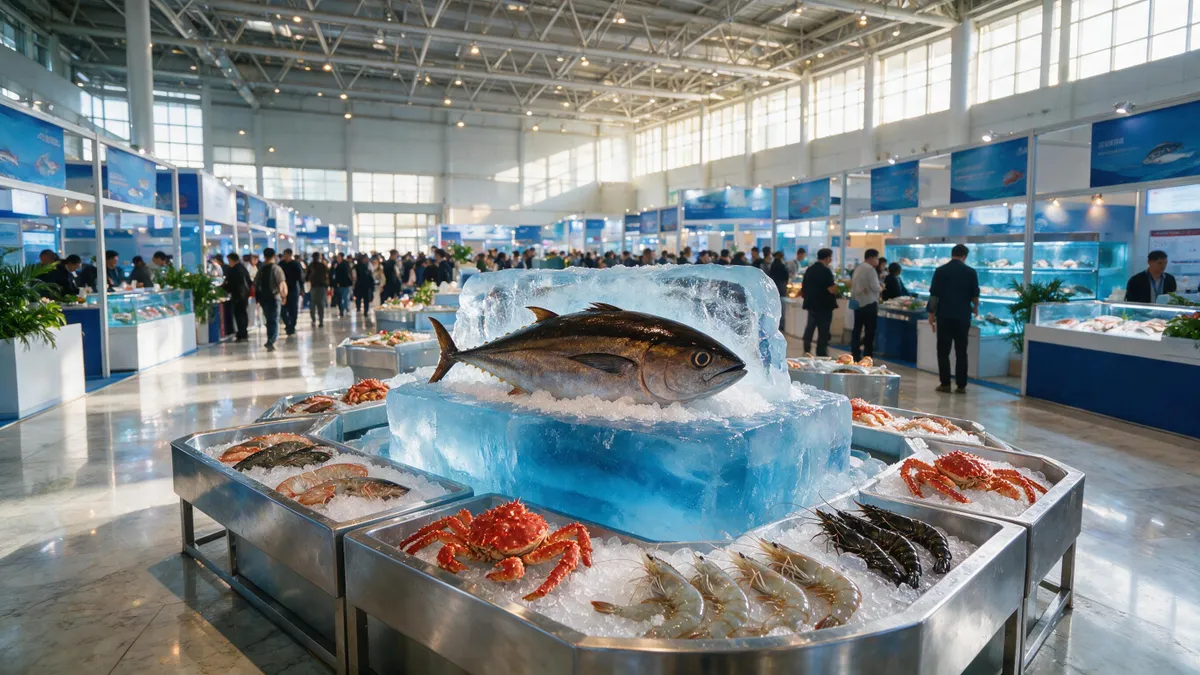
1. China Successfully Introduces Maltese Bluefin Tuna Eggs
Since China first imported Maltese farmed bluefin tuna in 2024, the annual import quota has exceeded 5,000 tonnes. On the first day of the Shanghai Fisheries Expo, Wang Zulan, the China-Malta Bluefin Tuna Cooperation Ambassador, was invited to attend and witness the Maltese chilled bluefin tuna cutting ceremony.
Industrial cooperation between China and Malta extends far beyond import and export trade. In early July, with the collaboration of the Europe-China Bluefin International Trade Center and Maltese fisheries aquaculture groups, the first batch of Maltese Atlantic bluefin tuna fertilized eggs successfully cleared customs and arrived at the Fujian Provincial Aquaculture Seed Industry Research Center.
It is understood that this batch of fertilized eggs has successfully passed quarantine isolation, risk monitoring, and invasive alien species risk analysis and assessment, as well as other regulatory approval procedures. The larvae have successively hatched from the eggs, with high survival rates and vigorous vitality. This marks a "zero breakthrough" in the overseas introduction of bluefin tuna fertilized eggs, filling a gap in the breeding technology for this species.
---
2. Russian King Crab Production Shifts: West Rises, East Declines
In 2026, Russia adjusted its national king crab fishing quotas, with the Far East quota reduced and the Barents Sea quota increased. The Barents Sea now accounts for 51.3% of Russia’s total red king crab quota, surpassing the Far East region for the first time.
At the exporter level, market impacts have already become apparent. UCN understands that the Russian Northwest Fisheries Alliance (Russian: СЗРК), which holds the largest Barents Sea red king crab quota, is expected to increase exports, while the Russian Crab Group, which primarily operates in Far East waters, has seen declining sales to China.
The Russian Northwest Fisheries Alliance comprises over a dozen Russian enterprises, holding 5,600 tonnes of red king crab and 8,200 tonnes of snow crab quotas, plus over 20,000 tonnes of Atlantic cod, haddock, and halibut quotas.
According to the Chinese shrimp, crab, and shellfish market report published by UCN, Barents Sea red king crab prices in Shanghai wholesale markets previously exceeded those of Russian Far East red king crab. However, in recent weeks, Barents Sea crab prices have declined, narrowing the price gap between the two.
---
3. Argentine Red Shrimp Season May End Early
In recent weeks, Argentine red shrimp frozen-at-sea catches have dropped sharply, and the production season may end in September.
A sales manager at an Argentine export company told UCN that over the past two weeks, actual catch conditions have not been optimistic, and the fleet has struggled to find new red shrimp resources.
Sales Manager: The catches were quite good at the beginning of the season, but they started declining over the past month. We are still trying to find new resources, but I think this season may end in September.
According to data from Argentina’s Ministry of Agriculture, Livestock and Fisheries, cumulative Argentine red shrimp production since the season began reached 104,230 tonnes, with 45,557 tonnes in July alone. In the first 11 days of August, an additional 11,861 tonnes were caught.
The company’s sales manager added that quotations for the Chinese market have stabilized since June, though at slightly lower prices than the same period last year.
Sales Manager: Prices are slightly lower than last year, but fortunately, they are still at a good level.
---
4. Indian Black Tiger Shrimp Sales Decline
An Indian exporter stated that demand for Indian black tiger shrimp in the Chinese market has weakened this year. While prices have remained largely stable, sales in the first half of the year were lower than the same period in 2025.
Supplier: We are still working hard to sell more black tiger shrimp to the Chinese market, but sales so far have not been ideal.
He noted that India’s black tiger shrimp annual production in 2026 is approximately 50,000 tonnes, roughly on par with last year. However, recent floods have damaged part of this year’s crop.
Supplier: Due to the recent floods, part of this year’s harvest has been lost. But we have not raised costs this year; it’s just that farm-gate prices are not particularly high.
During the fisheries expo, Indian 16/20 count black tiger shrimp was quoted at approximately $8.0/kg, largely flat compared to last year.
---
5. Ecuadorian Shrimp Price Rise Is Inevitable — Farmers Urgently Need to Recover Costs
After consecutive months of decline, Ecuadorian shrimp prices are rebounding. During the Shanghai expo, suppliers raised their quotes for the Chinese market, with 30/40 count frozen-at-sea prices increasing by an average of $0.20/kg, and some suppliers raising quotes by $0.30/kg, with a price range of $4.30–$4.50/kg. Salt-frozen retail products and large block quotes also rose accordingly, with 30/40 count increasing by $0.20/kg, and larger sizes seeing higher increases than smaller ones.
Juan Gómez-Behr, Commercial Director of AquaGold, a major Ecuadorian exporter, told UCN that with global buyers becoming increasingly active, Ecuadorian shrimp farmers, who had long faced low-price pressures, are now seeing an inevitable price recovery.
Juan Gómez-Behr, AquaGold Commercial Director: Over the past few weeks, especially the last two weeks and this week, we have seen some major Chinese buyers become very active. They have insufficient inventory and have to purchase to restock. This is exactly why prices are recovering.
Juan Gómez-Behr: The U.S. market is also very active, especially for value-added products. Ecuadorian shrimp prices are low, and many buyers are starting to see Ecuador as a viable option. In the past, when people compared Ecuadorian shrimp with shrimp from India, Thailand, or Vietnam, Ecuador was always more expensive. Now, the price gap has become very small, so more and more buyers are considering Ecuador as an alternative.
Nevertheless, Gómez-Behr stated that prolonged low prices have placed too much pressure on farmers, making this situation unsustainable in the long term.
Juan Gómez-Behr: At these prices, many farmers in Ecuador will not be able to make a profit. If these prices persist long-term, many of them will go bankrupt and switch to other industries.
Juan Gómez-Behr: Most integrated companies in Ecuador operate independently. Farms must be profitable, processing plants must be profitable, and feed mills must be profitable. The key is not to integrate everything together and ensure the whole system is profitable, but rather that each segment must be profitable. Otherwise, a particular segment becomes worthless to the whole.