
Japan Scallops: -17% Landings, Low Yield, Small Sizes(Sep 11)
Japan Scallop Landings Drop 17%, Meat Yield Only 10%-11%, Small Sizes Dominate
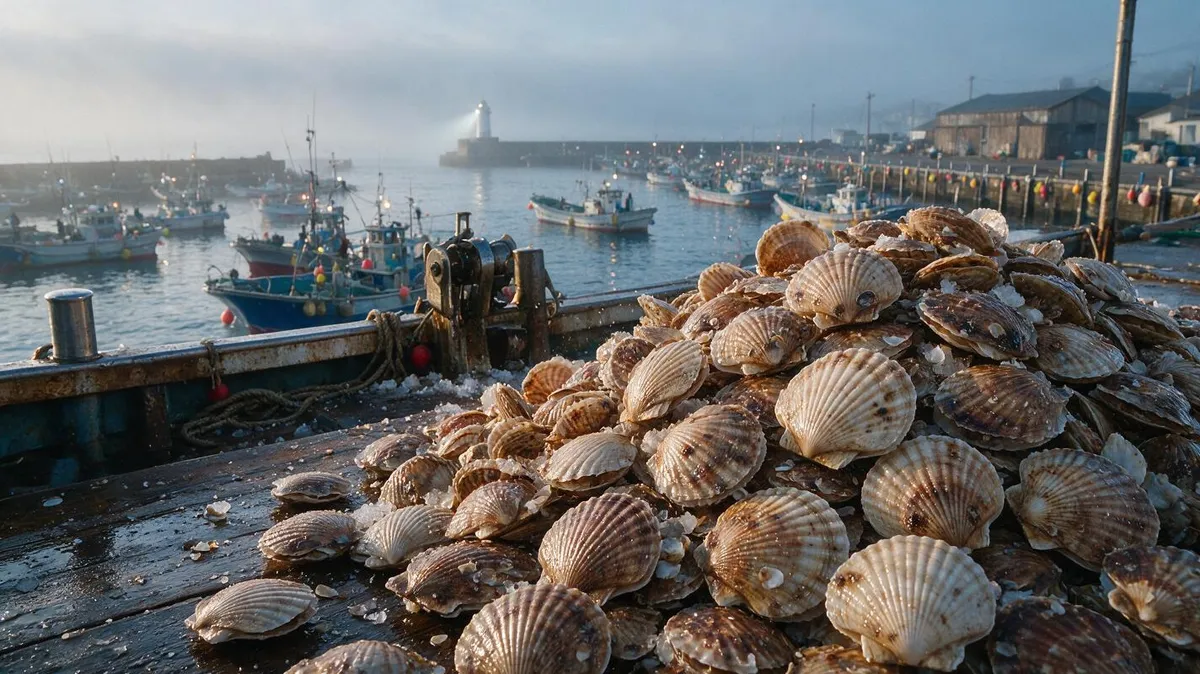
This year's scallop fishing progress in the Sea of Okhotsk off Hokkaido, Japan, is accelerating, but the challenge for processing enterprises has shifted from "not enough raw material" to "how much finished product can the raw material yield."
Cumulative Landings Approximately 150,900 Tons by End of August
According to industry data published by Japan's Suisan Shimbun (Fisheries News), cumulative scallop landings from the Sea of Okhotsk reached approximately 150,890 tons by the end of August, down 17% year-on-year.
Of this, the northern region accounted for approximately 64,990 tons, down 19% year-on-year, while the southern region recorded approximately 85,900 tons, down 16% year-on-year.
The scallop fishing season started notably slowly this year. By the end of June, cumulative production was down nearly 35% year-on-year. By the end of July, the decline had narrowed to approximately 24%. Entering August, landing speeds continued to recover, bringing the cumulative decline down to 17%.
The 2026 Sea of Okhotsk scallop full-year production plan is approximately 215,000 tons, about 15% lower than the previous season's actual production. By the end of August, approximately 70% of the plan had been completed, with the remaining approximately 64,000 tons still to be landed during the subsequent fishing season.
Another set of statistics from Japan's Suisan Keizai Shimbun (Fisheries Economics News) shows cumulative landings of approximately 147,900 tons by the end of August, down 20% year-on-year. The two datasets differ somewhat, likely due to differences in statistical scope. Until local fishery cooperatives release more detailed data, the two sets of statistics should be considered separately.
However, both datasets are broadly consistent in their assessment of current market conditions: this year's Sea of Okhotsk scallop landings remain below last year's levels, but the earlier lag in progress is being recovered.
Meat Yield Only 10%-11%
For processing enterprises, landing volume does not equal final supply volume.
Currently, the meat yield rate of Sea of Okhotsk scallop raw material is approximately 10%-11%, with some northern regions as low as 9%-10%.
A simple calculation illustrates the impact: if processing 1,000 tons of whole scallops at an 11% yield rate, the theoretical output would be approximately 110 tons of scallop meat. If the yield rate drops to 10%, the corresponding output is only about 100 tons. If it further drops to 9%, only about 90 tons.
This 1-2 percentage point difference is far from trivial for large-scale processing enterprises.
For IQF (Individually Quick Frozen) frozen scallop meat production in particular, how much of the raw material can ultimately be converted into commercial meat directly affects factory production costs and finished product supply volumes. Japan's Fisheries Agency has previously used a yield rate of approximately 11% as a reference value when estimating frozen scallop meat production.
Therefore, even if subsequent landing volumes continue to increase, if the meat yield rate remains at low levels, the actual quantity of scallop meat that processing enterprises can obtain may still fall below the level calculated simply from raw material landing volumes.
5S Size Category Accounts for a High Proportion
Size structure is another issue facing the processing side this year.
Currently, 5S size scallops account for a high proportion in the Sea of Okhotsk catch, corresponding to approximately 60-80 pieces per kilogram.
Compared with medium and large size scallops, small-size products have relatively limited sales channels in certain high-value international markets and are more dependent on the Japanese domestic market and specific processing applications.
For export-oriented processing enterprises, the simultaneous occurrence of declining total raw material volume and a high proportion of small sizes directly affects product structure.
If raw material supply decreases while medium and large sizes remain insufficient, what may truly be tight in the market may not be all scallop products, but rather frozen scallop meat in specific sizes.
This is a key area to watch in this year's market supply dynamics: the decline in raw material landing volume is narrowing, but the recovery speed of commercial scallop meat supply is still constrained by meat yield rates and size structure.
Raw Material Prices Decline from Highs
When the early fishing progress was severely behind this year, Sea of Okhotsk scallop raw material prices were at elevated levels.
By the end of June, raw material transaction prices in some areas ranged from the 300-plus yen to 400-plus yen per kilogram range, with some transactions even exceeding 500 yen per kilogram.
As landings gradually recovered in July and August, raw material prices began to fall. By the end of August, some reference prices had dropped to just over 300 yen per kilogram.
The decline in raw material prices provides some relief from procurement costs for processing enterprises, but it does not mean that the cost per unit of commercial meat will fall in tandem.
Assuming raw material prices remain unchanged, when the meat yield rate drops from 11% to 10%, producing the same quantity of scallop meat requires purchasing more whole scallops. The extent to which raw material prices decline must ultimately be combined with changes in yield rates to calculate actual processing costs.
This has led to a notable shift in this year's Sea of Okhotsk scallop market: raw material prices have fallen from their earlier highs, but supply pressure on the processing side has not fully disappeared.
Production Plan Cut 15%, Market Focus Has Shifted
The 2026 Sea of Okhotsk scallop full-year production plan of approximately 215,000 tons is itself about 15% lower than the previous season's actual production.
By the end of August, landings of approximately 150,900 tons had completed about 70% of the plan. As fishing progress recovers, there is still room for full-year landing volumes to continue increasing.
However, for processing enterprises and traders, what needs to be monitored this year is no longer just the final volume of raw material landed.
With the full-year plan reduced, cumulative landings down year-on-year, meat yield rates at only 10%-11% (as low as 9%-10% in some areas), and small-size scallops accounting for a large proportion, these factors collectively determine the final commercial volume that can enter the frozen processing and export markets.
For this year's Sea of Okhotsk scallop season, "landing volume" and "commercial scallop meat supply volume" can no longer be simply equated.