
Chinese Demand Weakens, Cod Prices Drop(August 21)
Chinese Buyer Interest Wanes, Norwegian and Russian Cod Prices Begin to Decline
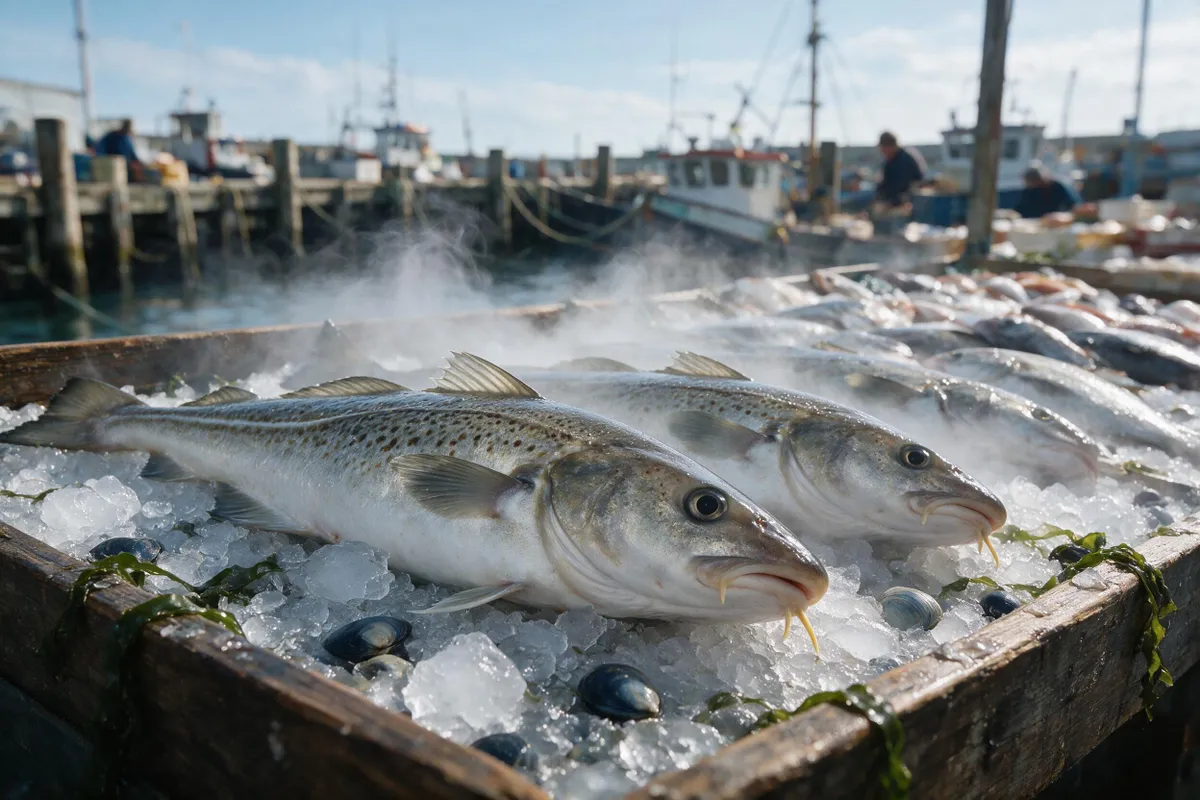
In Week 34 of 2026 (August 17-23), prices for frozen headed and gutted (H&G) Atlantic cod from Norway and Russia remained at elevated summer levels overall, but the market is showing signs of loosening.
Buyers and sellers from China, Russia, Norway, the United States, and the European Union generally reported that since early July, H&G Atlantic cod quotations have been operating within a relatively fixed range with little week-to-week change. However, Chinese processing plants' purchasing interest is waning, and some traders have begun to lower Norwegian cod offers.
H&G stands for 'Headed and Gutted,' referring to whole fish raw material that has been processed by removing the head and viscera. Chinese processing enterprises import these products and typically further process them into fillets, portions, and other products for supply to overseas and domestic markets.
The main contradiction in the current market is that buyers have grown fatigued with high prices, but next year's cod quota in the Barents Sea is expected to bring only limited supply improvement, so sellers remain reluctant to cut prices significantly.
Norwegian Cod Down USD 50, Top Quote No Longer Exceeds USD 10,700
In Week 34, the assessed price for 1-2.5 kg Norwegian H&G Atlantic cod was reduced by USD 50 per ton. This adjustment essentially confirms the slight price decline trend that emerged two weeks ago. Although quotes briefly rebounded in Week 33 (August 10-16), entering Week 34, the quoted range from the market narrowed, with no supplier offering above USD 10,700 per ton.
One U.S. buyer summarized the current market: 'H&G Atlantic cod prices are slowly declining, but still at high levels.'
Chinese processing enterprises have also begun receiving lower Norwegian cod offers. Some buyers believe that traders in Velsen, Netherlands, may hold inventory they wish to sell quickly, prompting some European holders to proactively lower their quotes.
However, the individual low prices reported by buyers have not yet been confirmed by a broader range of market participants and should not be directly regarded as mainstream transaction levels. From an overall market perspective, Norwegian cod prices have only marginally loosened and have not yet seen a significant decline.
Norwegian traders similarly indicated that current market purchasing interest for both cod and haddock is quite low. The summer holiday season has slowed European trading activity, with some buyers preferring to digest prior inventory rather than continuing to restock at high prices.
Raw Material Auction Prices Still High, Low Offers Near Cost Line
Despite weakened purchasing demand, the downside for Norwegian cod offers remains constrained by costs.
Currently, the Norwegian cod raw material auction price is approximately NOK 95 per kilogram. Based on this raw material cost, the lowest level of the Week 34 quoted range is already near the break-even line for traders and processing enterprises.
This means that if Norwegian raw material auction prices do not decline in tandem, it will be difficult for suppliers to sustain lower prices over the long term. Even if Chinese and European buyers continue to push for price reductions, Norwegian exporters have limited room for concessions.
In Week 33, the published cod ex-vessel price at a relevant Norwegian auction market showed a decline, but the transaction volume that week was only 255 kilograms. Given the extremely small sample size, this price lacks sufficient market representativeness and cannot be used to conclude that Norwegian cod raw material prices have broadly weakened.
The current Norwegian cod market is closer to a 'slow loosening at high levels' state rather than entering a rapid decline phase.
Russian Cod Stable, USD 1,000-1,100 Cheaper per Ton
Compared to Norwegian cod, Russian H&G Atlantic cod prices remained essentially unchanged in Week 34. Currently, the 1-2 kg Russian frozen H&G cod cost, insurance, and freight (CIF) price to China is approximately USD 1,000 to USD 1,100 per ton lower than comparable Norwegian raw material.
Such a pronounced price gap continues to make Russian cod attractive to price-sensitive processing enterprises. However, the Russian raw material price advantage has not directly driven significant Norwegian cod price cuts, owing to differences between the two countries' products in specifications, customer structure, supply stability, and end-market positioning.
Some European and North American customers still have specific demand for Norwegian raw material. Meanwhile, Barents Sea cod resource supply is unlikely to increase materially in the short term, and market expectations for the 2027 quota have not shown fundamental improvement.
Therefore, even with weakening Chinese buyer interest, the Russian cod price advantage can only exert some pressure on Norwegian offers, which is temporarily insufficient to break the high-price pattern across the entire Atlantic cod market.
Haddock Extremely Short, Buyers No Longer Fixated on Origin
Unlike Atlantic cod, which still has some landing volumes, haddock supply this summer has been extremely tight.
Entering August, some trawlers deemed the current season's haddock quality insufficient, opting to harvest other species instead. The noticeable reduction in fresh raw material available for trade has created two price tiers for haddock.
The higher prices primarily correspond to premium frozen inventory from earlier in the year still held in cold storage; the lower prices mainly correspond to recently caught summer haddock. Different harvest times and product qualities have led to significant quote variations within the same market.
Due to the extremely scarce supply, buyers' attention to product origin has diminished noticeably. For processing plants in urgent need of raw material, regardless of whether the product is from Russia or Norway, as long as specifications and quality meet order requirements, it may be purchased.
Currently, the price gap between Norwegian and Russian H&G haddock is only about USD 100 to USD 150 per ton, significantly smaller than the origin-based price gap for cod raw material.
However, this price cannot be directly compared on a fully equivalent specification basis. The Norwegian H&G haddock in the market assessment is 800 grams and above, while the Russian product is 500 grams to 1 kilogram. The different weight ranges mean that similar prices do not indicate that same-specification products are fully identically priced.
The extreme haddock shortage has diminished the importance of origin differences. The market's real concern has shifted from 'which country's product to buy' to 'whether sufficient supply can be found at all.'
U.S. Pacific Cod Holds at Historic Highs
While Atlantic cod shows slight loosening, U.S. Pacific cod prices remain strong. Entering August, prices for U.S. longline frozen H&G Pacific cod across all specifications and product forms were essentially flat compared to July, continuing to hold at historically highest levels.
Due to the traditional summer holiday season, market trading activity has cooled somewhat. Many buyers are digesting inventory purchased earlier in the year while observing the progress of the B-season harvest.
The U.S. Pacific cod B-season harvest began in mid-June and is still ongoing. Although the trading pace has slowed, the market has not experienced a genuine cooldown. One supplier noted that the demand weakness signals appearing in the Atlantic cod market have not transmitted to the Pacific cod market.
In other words, the current reduction in Pacific cod transactions is more attributable to holidays and inventory digestion, and does not indicate that underlying demand or price fundamentals have noticeably weakened.
High Prices Loosening, but Market Unlikely to Drop Rapidly
Overall, Week 34 of the global cod market showed pronounced species divergence. Norwegian H&G Atlantic cod prices were cut by USD 50 per ton, Chinese buyer interest waned, and some European traders began attempting to sell inventory; Russian H&G cod offers held steady, continuing to attract processing enterprises with a USD 1,000-1,100 per ton advantage.
Haddock remained strong due to extreme supply shortages, with the price gap between Norwegian and Russian products narrowing to USD 100-150 per ton. U.S. Pacific cod, despite slower trading, held at historically highest price levels.
In the short term, declining Chinese buying interest may continue to pressure Norwegian cod prices. However, high raw material costs, limited Barents Sea supply improvement, and the absence of clear quota increases for next year will constrain the downside.
Therefore, the cod market is more likely entering a phase of high-level consolidation and gradual adjustment rather than a rapid shift to across-the-board declines. Going forward, Barents Sea supply, the pace of European inventory digestion, and U.S. Pacific cod B-season harvest conditions will be the primary factors influencing price trends.