
New Zealand Apples: Exports to China Exceed 90,000 Tons, New Season Exports May Reach 410,000 Tons(Nov 3)
New Zealand Apples: Exports to China Exceed 90,000 Tons, New Season Exports May Reach 410,000 Tons
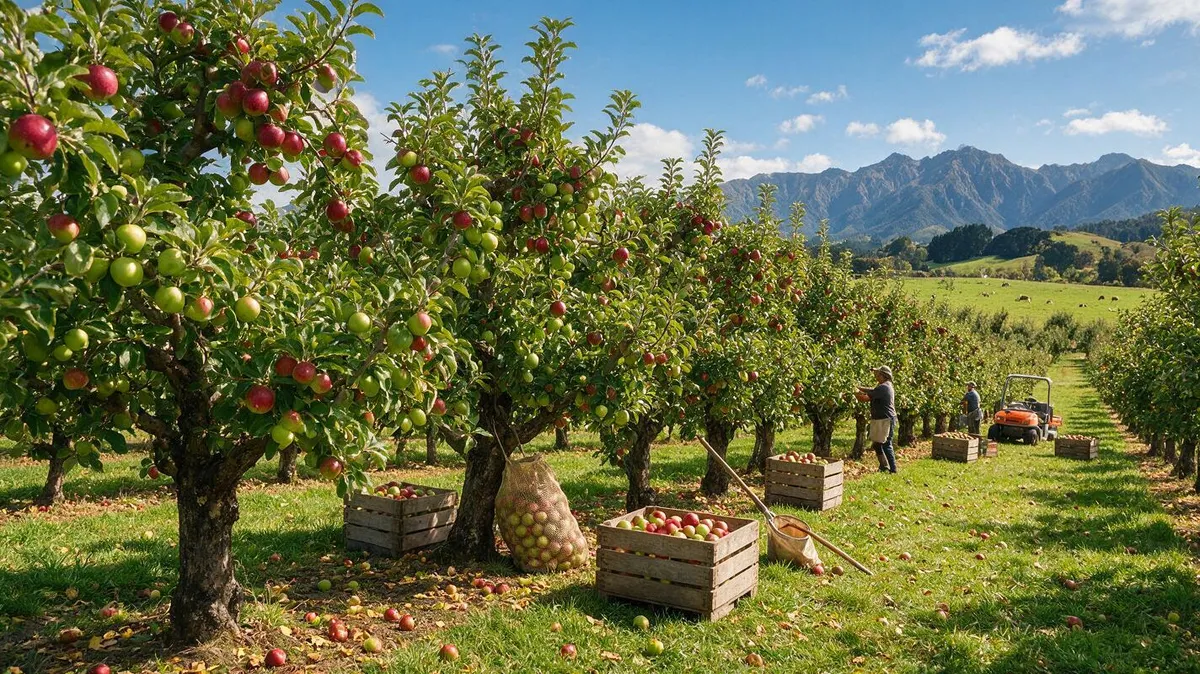
After being devastated by Cyclone Gabrielle in 2023, the New Zealand apple industry is recovering strongly. The latest USDA report forecasts that New Zealand's commercial apple production for the 2026/27 season will reach 590,000 tons, with export volume expected to rebound to 410,000 tons, the highest level since the 2020/21 season. China continues to rank as New Zealand's largest apple export market, with exports growing from 41,954 tons in 2023 and 64,788 tons in 2024 to 82,422 tons in 2025. From January to August 2026, New Zealand apple exports to China reached 91,349 tons, up 17.74% year-on-year.
Production and Acreage: Recovering to Pre-Pandemic Levels, Second-Highest on Record
For the 2026/27 season, New Zealand apple planted area is projected at 11,250 hectares, with harvested area at 10,900 hectares and commercial production of 590,000 tons. If realized, production will recover to pre-pandemic levels and become the second-highest on record. For the 2025/26 season, planted area was 11,100 hectares, harvested area 10,800 hectares, and commercial production an estimated 585,000 tons.
Production recovery comes from two sources: first, young orchards rebuilt after the cyclone are entering peak production; second, the industry is accelerating the shift from traditional low-return varieties like Braeburn to premium specialty varieties such as Envy, Dazzle, and Fuji. Braeburn's share of planted area has dropped from 22% in 2011/12 to less than 4% in 2025/26.
By region, Hawke's Bay remains the absolute core, accounting for 65.4% of New Zealand's apple planted area, followed by Tasman at 22.8%, Gisborne at 5%, Otago at 4.2%, Canterbury at 1.6%, and Bay of Plenty at 0.9%.
El Nino Impact: Eastern Production Areas Face Warm, Dry Pressure
The report specifically notes that New Zealand will enter the 2026/27 production season under the influence of a strong El Nino. New Zealand earth science agency ESNZ expects El Nino to dominate weather patterns through spring and early summer, bringing more frequent westerly airflow, stronger winds, and greater weather variability.
For major apple production areas, the impact shows an "east-west divergence": eastern regions including Hawke's Bay, Gisborne, Canterbury, and Otago are more likely to experience warm, dry weather with near-normal or below-normal rainfall, while western and southern areas may see more frequent rain. Prolonged drought, strong winds, and temperature fluctuations could raise production costs and affect fruit quality.
Overall Exports: 410,000 Tons in Sight, Asian Markets Become Main Engine
New Zealand apple export volume for the 2026/27 season is projected at 410,000 tons, up 5,000 tons from the revised 405,000 tons in 2025/26, marking the highest level since the 2020/21 season.
Based on January-August 2026 actual data, New Zealand apple exports have reached 385,840 tons, up 5.98% year-on-year. The report states that export revenue this season is approximately NZD 1.25 billion (about USD 712 million), a record high, with some export volumes still pending shipment.
By market, Asia is the primary growth engine: exports to China reached 91,349 tons, up 17.74% year-on-year, as the largest market; followed by India at 50,657 tons, up 33.76%; Taiwan at 44,824 tons, up 3.95%; Vietnam at 42,283 tons, up 10.75%; and Hong Kong at 20,318 tons, up 48.44%. In contrast, exports to the EU and UK declined 52.09% and 17.16% respectively, while exports to the US fell 4.31%.
China Focus: Largest Market Position Solid, Growth Rate Still Impressive
For the Chinese market, New Zealand apple supply is increasing with strong demand. Based on year-to-date trade data, China accounts for 23% of New Zealand apple exports and remains its largest fresh apple export market. From January to August 2026, New Zealand apple exports to China reached 91,349 tons, up 17.74% year-on-year. By calendar year, New Zealand apple exports to China grew from 41,954 tons in 2023 and 64,788 tons in 2024 to 82,422 tons in 2025, showing a clear growth trend.
New Zealand exporters are leveraging their extensive free trade agreement network to expand their competitive advantage, targeting Asian markets, particularly Vietnam, Taiwan, India, and China, as key destinations for new season exports. Exporters also plan to promote specialty varieties in Northern Hemisphere counter-seasonal markets such as the EU and US.
In terms of varieties, Royal Gala remains the export mainstay, but demand for specialty varieties such as Envy, Dazzle, and Fuji is rising. For Chinese consumers, this means New Zealand apple supply will be more abundant, with further diversification of the variety structure.
Production recovery, export rebound, and strong Asian demand are the three main themes of the new New Zealand apple season. For the Chinese market, the "return" of New Zealand apples means more ample supply and more intense quality competition.
-
Indian Black Tiger Shrimp Accelerates China Market Expansion, Prices Decline with Increased Supply(Nov 3)6525
-
New Zealand Apples: Exports to China Exceed 90,000 Tons, New Season Exports May Reach 410,000 Tons(Nov 3)5944
-
Egg: Price Rebounds, Beware of a Flash in the Pan(Nov 2)5462
-
Norway's Largest Farmed Cod Producer Ode Debuts at Qingdao Fisheries Expo, Targets 20% of Cod Sales to China by 2030(Nov 2)9445
-
Chilean Cherries Enjoy Fast-Track Preferential Import via Hong Kong-Zhuhai-Macao Bridge(Nov 2)5650