
Ecuadorian White Shrimp Size Premium Distorted: Large Sizes Overpriced by $0.5/kg, Price Correction Expected After Fisheries Expo(Oct 28)
Ecuadorian White Shrimp Size Premium Distorted: Large Sizes Overpriced by $0.5/kg, Price Correction Expected After Fisheries Expo
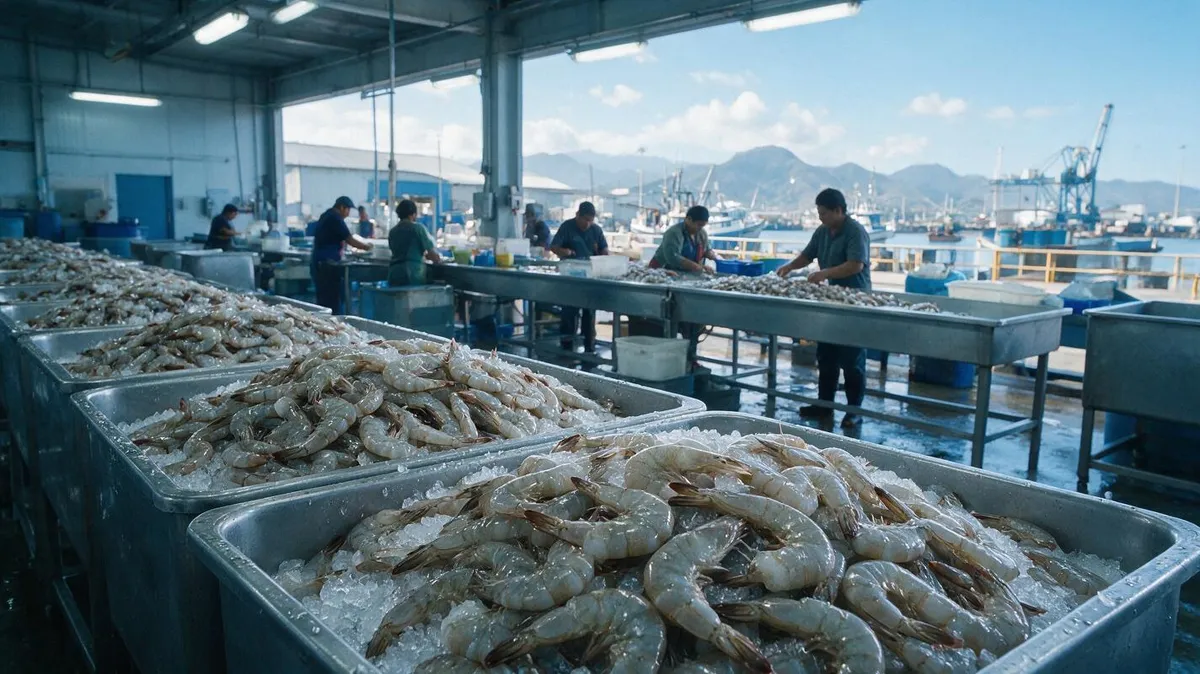
Source: World Food Network (shijieshipin.com)
With the Qingdao Fisheries Expo opening on October 28, Ecuadorian plants have preemptively cut prices to lock in domestic orders, but market transactions have been lackluster as buyers adopt a wait-and-see stance. Behind this pre-expo maneuvering lies a convergence of four conflicting forces: origin power supply, harvest pacing, size structure, and domestic inventory, signaling considerable downside risk ahead.
In Week 43 (October 16-22), the average export price of Ecuadorian white shrimp (HOSO) across all sizes fell by $0.10/kg week-on-week: 20-30 count at $3.60/kg, 30/40 count at $3.20/kg, 40/50 count at $2.60/kg, 50/60 and 60/70 count both at $2.20/kg, with some sizes falling below historical lows. Compared to early September (Week 37), the 30/40, 40/50, and 50/60 sizes have cumulatively declined by $0.10, $0.10, and $0.40/kg respectively, with mid-small sizes dropping more steeply.
The price spread between adjacent sizes has widened noticeably. The 20-30 count commands approximately $0.4/kg more than the 30-40 count, and the 30-40 count is about $0.6/kg higher than the 40-50 count, averaging roughly $0.5/kg, whereas the industry's long-term adjacent size spread benchmark is approximately $0.3/kg. The current premium on large sizes is clearly excessive.
The root cause traces back to Ecuador. Persistent power supply shortages have disrupted processing plant operations, constrained shrimp purchasing willingness, and suppressed pond-gate prices. The Ecuadorian National Chamber of Aquaculture (CNA) warned on October 14 that rising electricity costs and power outages have affected normal business operations. Slow purchasing and processing mean farmers must keep shrimp in ponds longer, where they continue growing, leading to an accumulation of large-size supply in 20/30 and 30/40 counts. This is not intentional large-shrimp farming but a size structure shift forced by processing bottlenecks.
As origin pushes more large sizes, domestic inventory structure has become misaligned. Port and distributor inventories of older-dated stock are concentrated in 20/30 and 30/40 large sizes, while the best-selling products at the retail end are the cheaper 40/50 and 50/60 mid-small sizes. Large-size quotes are high, market acceptance is weak, and destocking is slow, while mid-small sizes circulate smoothly as the current hot sellers. With inventory out of sync with demand, buyers naturally resist heavy advance commitments, explaining why factory promotions have failed to generate transactions. Most are waiting to see the factories' bottom line at the expo.
The Qingdao Fisheries Expo serves as the primary order-taking window between Ecuadorian plants and Chinese buyers, and as a watershed for short-term market dynamics. If sufficient solid orders are secured at the expo, prices may stabilize and spreads gradually correct. If orders fall short of expectations, prior promotions will prove ineffective, and plants may resort to post-expo concentrated price cuts to recover capital, with large sizes bearing the brunt.
Looking further ahead, from now through May next year, Ecuadorian shrimp production will progressively increase, sustaining upward supply pressure. Ecuadorian central bank data shows that from January to August 2026, shrimp exports reached 1.1 million tons, up 19.8% year-on-year, with export value of $6.561 billion, up 18% year-on-year, with volume growth outpacing price growth. While banquet, gift box, and premium channel recovery may bringphased demand for large sizes, demand expectations do not equate to price increases. In a production expansion cycle, the strength of demand recovery may not absorb the continuous stream of new supply. The scenario of being bullish on large sizes while prices continue to decline is not uncommon, and the risk of sustained price erosion warrants vigilance.
-
Ecuadorian White Shrimp Size Premium Distorted: Large Sizes Overpriced by $0.5/kg, Price Correction Expected After Fisheries Expo(Oct 28)9298
-
China Successfully Exports Large Quantities of Fresh Berries to Russia(Oct 28)7763
-
Eggs: Ample Supply, So Why Are Egg Prices Relatively Strong?(Oct 27)8592
-
Icelandic Headed and Gutted Cod Breaks 1,000 ISK/kg, Benchmark Grade Weekly Sales Plunge to 25 Tons(Oct 27)5686
-
Myanmar Avocados Poised to Enter the Chinese Market(Oct 27)7578